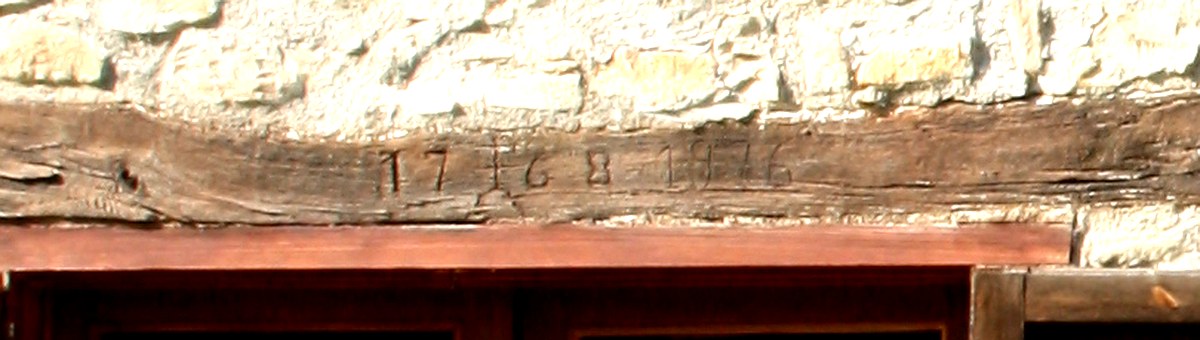
The lintel above the front door. On the left, 1768. On the right, 1976.
Two dates on one beam
Above the front door of the farmhouse there is a wooden beam with two dates carved into it, separated by a gap. It is not one inscription but two, made more than two centuries apart.
The one on the right is 1976, the year the parents of Josep Heras Gomis, today co-owner of the farmhouse, finished rebuilding the house, which had been a ruin for decades. It is the date the family has always had in mind, because there are people who saw that work.
The one on the left is 1768, and it is the date of the house. It did not read clearly to the naked eye: the carving is worn and, depending on how the light falls, the two numbers blur into a single mark. Enlarging a photograph of the façade at full resolution, the number appears whole and unambiguous.
A date carved into a beam proves nothing on its own. The beam could have arrived later: timber is reclaimed in rebuilds like this one, and if that piece had come from another house, 1768 would say nothing about this one. That is the first objection to answer, and the only way to answer it is to ask someone who was there.
One person who saw that work still remembers it: Conxita Gomis Bartomeus, Josep's mother. What she says is that this beam was precisely one of the things the ruin already had when they began rebuilding in 1976. It is not timber brought from anywhere: it is the house's own wood.
And there is a second detail pointing the same way, one that does not depend on anybody's memory. Whoever rebuilt in 1976 carved their year beside the old number, not over it. Someone putting a date on any old beam puts it where it fits; someone placing it carefully next to another is acknowledging that the first one already belonged to the house.
There may still be something more on the beam. The carving is badly worn and the photograph only picks up the numbers clearly; early in the morning, when the sun falls sideways and the relief casts a shadow, initials or a cross that cannot be read today might appear.
It is the only direct dating evidence this house has, and there is no other in sight. The Land Registry goes back no further, because the property was first registered in 1981, and the farmhouse does not appear in the Architectural Heritage Inventory of Catalonia.
Nor is it a rarity in these valleys. To the west, right against the property, lies the estate of les Eres de Guardiolans, already in the municipality of Vilada: its family chapel has the date 1637 carved into its lintel. Carving the year into the stone or the wood of the doorway was, quite simply, what people did here.
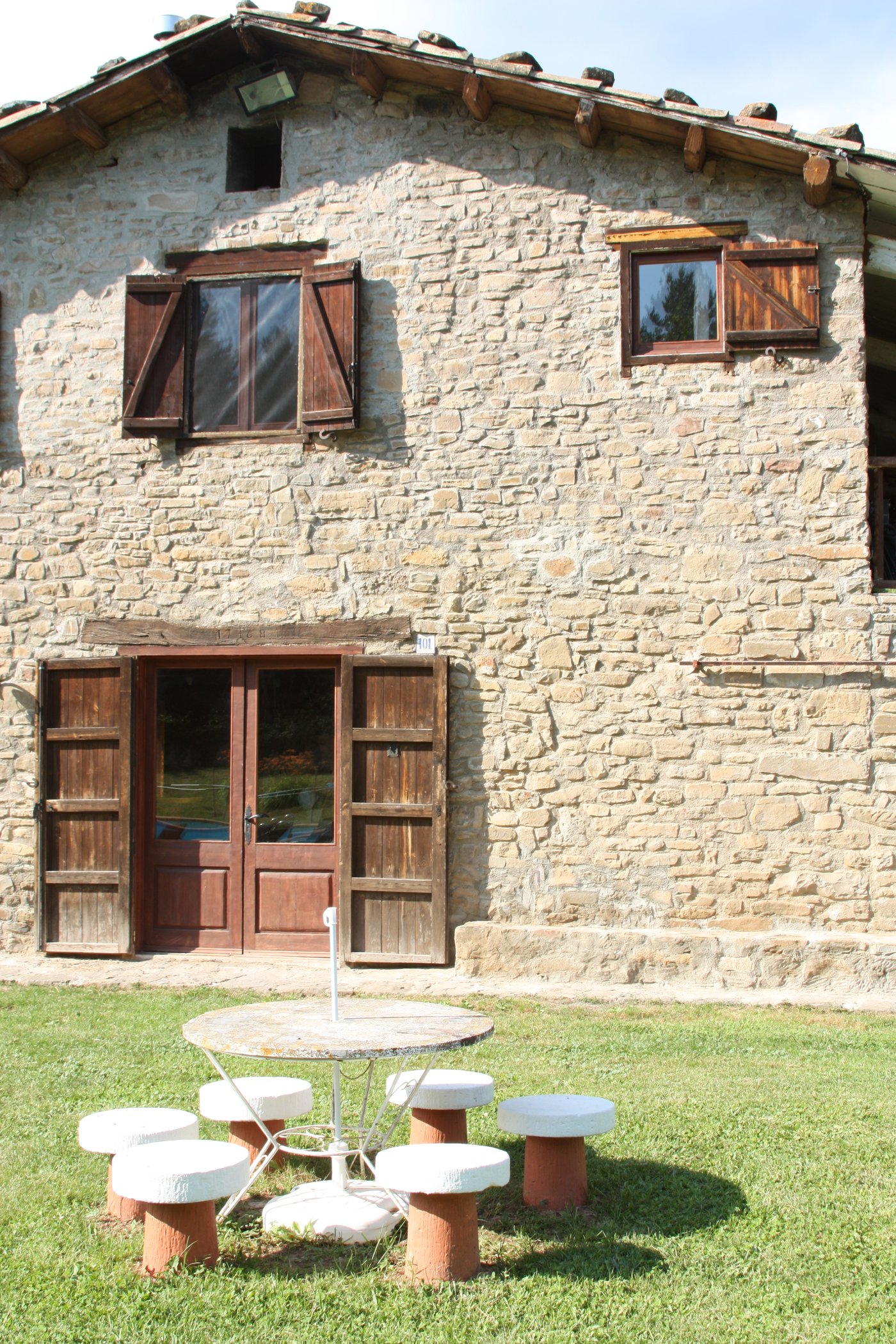

A house cut out inside the estate
To understand why El Pati exists you first have to look at where it is. And where it is, is not next to the Capdevila estate: it is inside it.
The registry description of the large property puts it like this: «within this property there are two enclaves formed by the Capdevila and Pati houses, which are properties independent of the one described here». Two houses cut out from inside a single estate, like two holes in a cloth.
And El Pati's own registry entry adds the detail that explains everything. It is property number 756 of Borredà, and it is described thus: «House called Pati, in the Capdevila place, in the municipality of Borredà […] It borders all around: to the East, North and South, with the Capdevila estate, through which it has access, and to the West, with the Las Heras de Guardiolans estate». Three of its four sides face the estate, and the fourth faces the neighbouring house, already in the municipality of Vilada.
That shape is no accident, and it is not the shape of a property bought from a neighbour. Someone who buys a house from a third party does not end up without a way in of their own; someone who cuts a piece out of their own land to build on it does. It is the shape left behind by a father raising a house for a child on the land below.
The Registry does not say so in those words, of course, because a land registry does not explain intentions. But the geometry of the property and what the family tells say exactly the same thing.
It is worth making clear that this description is the old one. El Pati is today an independent property, with its own land and its own access. What is described here is the shape it had on the day it was built, not its present situation.
Capdevila, the house above
The Capdevila farmhouse is documented from the 16th century as one of the holdings of the monastery of Santa Maria de Ripoll in the municipality of Borredà, under the abbot's jurisdiction. It is listed in the Architectural Heritage Inventory of Catalonia under the identifier IPAC 3177.
At home the name has always been said as one word, Capdevila, and nobody has ever known whether it comes from the place or from the family.
«The house in Borredà, in the municipality of Borredà, is in the middle of the woods. They called it Capdevila. I don't know whether Capdevila really was the name, or whether it was because they were rich and people called them the caps de vila, the heads of the town. Mind you, I'm talking about perhaps a hundred years back, or more.»
Conxita Gomis Bartomeus, recorded in 2026
What is certain is that it ended up being both things at once: the name of the house and the surname of those who lived in it. And the house stands high up, something that was also told with intent: «it was a house that stood at the very top of a mountain, the way people used to do with feudal castles; it seemed to be so they could command it all, the whole forest…».
The inventory record explains what they did for a living: «the Capdevila family combined farming with working wool; members of this family settled in the town of Borredà and joined the Guild of Wool Carders and Weavers of Borredà. By the 18th century they are recorded as wholesale wool merchants». That is a big step up: from working wool to buying and selling it in quantity.
In the papers, the estate is still measured the old way: four hundred and forty-seven cuarteras and eleven cuartanes of wheat-sowing surface, local measure. That is about 162 hectares. Capdevila is property number 7 of Borredà, one of the first registered in the municipality; since that measurement it has been progressively divided, and today that surface is spread across several properties.
The 18th century is the house's best economic moment, and it is when the building happens. The inventory record dates to that century the extension of the Capdevila farmhouse on its north side, and the lintel dates the building of El Pati to 1768. The date on the beam is not an isolated fact: it falls exactly where the documents say there was money to build.
The great house is not a ruin: the inventory record places its restoration between 1990 and 1995, and today Capdevila is a private home, in private hands and in good condition. It is not part of Pirineu Turístic and it cannot be visited.
One last detail worth a smile: the official address the inventory record gives for reaching Capdevila is «Vilada to Borredà road, km 36, track on the left towards el Pati». The Generalitat's heritage catalogue locates the great house by using the small one as its landmark.

Why it was built
This is no longer in the papers. The family tells it, and it has reached us by word of mouth, without anyone ever writing it down.
«There was a lot of work in these farming houses. They all had farmhands. And the master —they called him the master back then, let's say the boss or the manager, the master of the house— had a farmhand they thought very highly of, a very hard worker and very well regarded, very. And they had a daughter. They fell in love, or they married them off, I don't know, because in those days… And he said he would build her a house down below, in the courtyard. And down in the courtyard they built another house, which today is a rural guest house, and it's very pretty.»
Conxita Gomis Bartomeus, recorded in 2026
There are two things in that account worth leaving unsmoothed. The first is the «they fell in love, or they married them off, I don't know»: the teller leaves both doors open instead of settling for the pretty version, and that is exactly what makes an oral tradition believable.
The second is who the groom was. Not a neighbouring landowner, nor a younger son from another strong house: he was the farmhand of the house itself, a working man. A daughter of a well-off house married to an employee, and a father resolving the situation the only way he could without splitting the estate: by building them a house down below, in the courtyard, inside his own land but apart from the farmhouse.
That is where the name comes from. The pati — courtyard — was the lower part of the estate, and the house built there kept the name of the spot for good: El Pati. It has never been called anything else, and that too is underlined in the telling: «they never lost the name, it was el Pati».
What we do not know is what they were called. No name appears in the recording, neither the daughter's nor the farmhand's, and that is the missing piece that would close the story.
The chapel, and the bell nobody has heard since
The masters of Capdevila were powerful enough to have a chapel of their own. Not an oratory inside the house: a small church a few metres further down, with room for about thirty people, to which the priest from Borredà would climb up to say mass.
The reason handed down is practical, not devout: they were very Catholic, the village was far away and there were days when the work in the fields would not let them go down. If they could not go to church, the church would come to them.
It is listed, and it has a name. The inventory record says it in a single line: «Near the farmhouse stands the family chapel dedicated to Sant Jaume». Nothing more: no style, no date, no condition. It is the cleanest coincidence in this whole story: an account that arrives purely by word of mouth, with no paper in between, matches the heritage catalogue down to where the chapel stood and whom it was dedicated to.
And at home it has always been said that this chapel had an extraordinary bell, made of platinum, that could be heard from a long way off.
«When we went out looking for mushrooms, we were always looking for the bell. Who puts up a platinum bell? Platinum. Because they said its tone carried. They said that was how it could be heard from far away and people could come; when the bell rang it meant mass was starting.»
Conxita Gomis Bartomeus, recorded in 2026
When the war came, the master had it hidden, and he gave the job to a farmhand of the house. That part is always told the same way: the order comes from the master, not from the farmhand acting on his own. What changes the story is the sentence it closes with.
«They said they had hidden it, that the master had told a farmhand of the house to hide it. And they say he hid it. I don't know whether he hid it or whether he took it away.»
Conxita Gomis Bartomeus, recorded in 2026
That is not a doubt about where the hole is: it is a doubt about the man they asked to hide it. At home it has never been known whether he buried it or kept it. And if he took it away, there is no bell to find, and we have spent generations looking for something that has been somewhere else for a hundred years.
Nobody alive has seen it or heard it. It has never turned up. In the family it has survived as a joke repeated every time someone digs a hole or goes out after mushrooms: see if you find the bell.
That the chapel lost what it had is no extraordinary case either. At the neighbouring house, les Eres de Guardiolans, the family chapel held a Baroque altarpiece and some paintings by Antoni Viladomat until the war, and they are no longer there. What is told here is, quite simply, what happened in almost every private chapel in these valleys.
The fire and the gold in the walls
There is one more story, from the middle of the last century, which is not about El Pati but explains why the old houses in these woods are so thoroughly wrecked, and why a whole family spends its life looking for a bell.
After the war, when migration began to arrive in Catalonia, it reached Borredà too. A widowed father came with two or three children and rented one of the oldest, most battered houses in the village, because he could not afford the others. He worked cutting firewood in the forest.
One morning, while they were cutting, they heard the bells ringing for fire.
«The language of the bells — people understood one another, because there were no mobile phones.»
Conxita Gomis Bartomeus, recorded in 2026
If someone had to be warned and nobody knew where they were, the bells were rung. Everyone dropped their work and went down to the village to help put it out.
It was that man's house burning. And what has been told ever since is that, with the fire, gold began to come out of the walls. The old masters had not made a hiding place: they had spread the coins throughout the house.
«In the walls… the gold was running out. Those who had hidden coins had them all over the rooms of the house, they had sort of walled them in there. The poorest man in the village, who arrived at a house full of gold.»
Conxita Gomis Bartomeus, recorded in 2026
Can that happen? The figures leave room for it. A fully developed house fire runs between 800 and 1,000 °C, with peaks of 1,100 to 1,200 °C, and a gold coin of coinage alloy melts at around 930 to 1,000 °C. The condition is where they were: inside a thick stone wall the heat does not reach, but in a thin partition, beside the hearth or in the cavity of a wooden frame, it does. And one detail of the account fits: what is told is gold running down the wall, not a chest being found. A melted coin loses its shape and becomes a blob.
From that day on everyone took it for granted that the ruined houses in the woods were hiding gold, and they started pulling them down to look for it. That is why many of these houses did not fall on their own. Of a stone house it was said at home that «it isn't that easy to bring down», and of those that are wrecked beyond repair, that «they were handled a great deal».
It is worth saying plainly: the Capdevila farmhouse is today a restored private home, with its own owners, and neither the house nor its chapel belongs to Pirineu Turístic. They cannot be visited, there is no signposted path leading to them and the land is private. This story is told here because it is part of the memory of the house, not as an invitation to go looking for anything.

From ruin to today: three renovations in fifty years
At some point in the 20th century the house was left empty, and from empty it became a ruin. That is the usual end of the isolated farmhouses of the Berguedà: people move down to the village, the roof holds for a few years and then stops holding. By then El Pati was what it had always been, a farming house with the livestock below: «the cows were downstairs, and with the warmth the animals gave off… and the bedrooms upstairs». Little of that building was left standing: «upstairs, pieces that could fall, collapsed, the floor».
The first renovation began in 1974 and was finished in 1976. The whole house was rebuilt keeping whatever was sound, the lintel beam included, and the new year was carved beside 1768 and not over it. That decision — carving beside — is the reason the house can be dated today.
The second came in the mid-eighties. A bedroom and a bathroom were added, and the great wooden room was built with the central-hood fireplace that is still the heart of the house. Later the cellar was fitted out, taking advantage of the fact that the temperature down there never changes.
The third, between 2022 and 2024, changed the use of the house as well as its condition: a separate extension was built for the owning family, and the farmhouse itself was set aside entirely for guests. Whoever stays at El Pati today has the house to themselves. Inside, a new bathroom was built, the furniture and the decoration were renewed — handmade with timber from these same woods — and the garden was redone.
Half a century separates the first works from the last, and the principle has not changed: repair what is there rather than replace it.
Today El Pati is a rural guest house with tourist registration HUTCC-070552-94 and room for twenty people.
Whoever stays in it sleeps inside a house that a father built for his daughter and for the farmhand she married, more than two hundred and fifty years ago.
El Pati is not the only house in this valley, nor the only one with a history: Casteió, Canemars, les Eres de Guardiolans and Pradell complete the neighbourhood, and something different ties us to each. We tell it in the neighbouring farmhouses.
Who tells this story
Everything that is not in the documents comes from the recordings Conxita Gomis Bartomeus made in 2026, in her seventies. There are six recordings, an hour and a half in all, made in Catalan; the quotations on this page are translated, and her hesitations and doubts have been kept exactly as she says them.
She had heard it from her aunt by marriage, Maria Elisa Heras Heras, who in turn had heard it from her own mother and grandmother. The narrator says so herself, without being asked: «An aunt of mine had told me, she knew things; she remembered, or her mother and her grandmother had told her, and that is how it reached me.»
That chain matters, because it changes the nature of what is being told. If the house is from 1768, by the time Maria Elisa was telling Conxita, it had already happened more than a hundred and fifty years earlier. This is not a memory from two generations back: it is oral tradition passed from mouth to mouth across six or seven generations, which has reached us with a date carved above the door to confirm it.
It is also worth saying what it is not. Nobody alive saw the chapel in use, or heard the bell, or knew the daughter or the farmhand. What there is, is a story handed down and a set of documents which, by independent routes, point to the same century.
What we do not know
We do not know what the daughter of Capdevila or the farmhand she married were called: no name appears in the recordings. The record of that marriage ought to be in the parish books of Borredà kept at the Episcopal Archive and Library of Vic, and the 1768 date narrows the search to a few years.
Nor do we know when the Heras surname enters the house, because the masters of Capdevila were called Capdevila. If either of those turns up one day, it will be added here.
Documentary sources
- The date 1768 carved into the lintel above the front door, on an original beam of the building.
- Architectural Heritage Inventory of Catalonia, record of the Capdevila farmhouse in Borredà (IPAC 3177): 16th-century dating with an 18th-century extension on the north side, family chapel dedicated to Sant Jaume near the farmhouse, the abbot of the monastery of Santa Maria de Ripoll as jurisdictional lord, the Guild of Wool Carders and Weavers of Borredà, and restoration of the house between 1990 and 1995.
- Heritage documentation on les Eres de Guardiolans (Vilada): Baroque family chapel, with the date 1637 carved into the lintel and a two-opening bell gable, which before the war held a Baroque altarpiece and paintings by Antoni Viladomat. The sources disagree on its dedication: the Barcelona Provincial Council record gives it to the Santíssim Nom de Jesús and the Generalitat's Pla d'actuació to Santa Magdalena.
- Land Registry of Berga, property 7 of Borredà (Capdevila estate) and property 756 of Borredà (Pati house): surface area, enclaves, boundaries and access.
- Deed of segregation and dissolution of co-ownership of the Capdevila estate, Manresa, 5 October 2004.
- Episcopal Archive and Library of Vic, Borredà parish collection: baptisms from 1577, marriages from 1640, notarial books from 1307 to 1929.
- Recordings of Conxita Gomis Bartomeus, 2026, kept by the family.
Frequently asked questions about the history of the El Pati farmhouse
How old is the El Pati farmhouse?
It dates from 1768. The date is carved into the wooden lintel above the front door, on an original beam that was already in the building before the 1976 rebuild. Beside it the year 1976 is also carved.
Why is it called El Pati?
Because it was built in the courtyard — pati in Catalan — the lower part of the Capdevila estate. According to family tradition, the master of Capdevila had the house built there for a daughter who married one of the farmhands. The name of the spot became the name of the house and has never been lost.
What is its relationship with the Capdevila farmhouse?
El Pati is an independent property located inside the Capdevila estate, an enclave reached by crossing the estate itself. Capdevila is documented from the 16th century as a holding of the monastery of Santa Maria de Ripoll and is listed in the Architectural Heritage Inventory of Catalonia under the identifier IPAC 3177.
How do you know the dated beam is original and not reclaimed timber?
Because that beam was already in the ruin when the house was rebuilt in 1976, according to the testimony of someone who lived through those works. It was not brought from anywhere else. In addition, whoever rebuilt carved the year 1976 beside the old number rather than over it, which indicates they recognised the earlier inscription as part of the building.
Is the story of the hidden bell true?
It is family tradition, not a documented fact. At home it has always been said that the chapel of Sant Jaume at Capdevila had a bell that could be heard from a long way off and that during the civil war the master had it hidden. It has never turned up, and the family version itself doubts whether the man charged with hiding it actually buried it or took it away.
And the story of the gold in the walls?
It is an episode from the middle of the last century told in the village: an old house in Borredà caught fire and, with the fire, out came the coins that former owners had walled in. From then on the idea spread that the ruined houses in the woods were hiding gold, and many were pulled down looking for it. It is not documented, but the temperatures of a house fire are compatible with what is told.
Can the Capdevila farmhouse or the chapel of Sant Jaume be visited?
No. The Capdevila farmhouse is today a private home, restored between 1990 and 1995 by its current owners, and the chapel of Sant Jaume stands near it on private land. Neither belongs to Pirineu Turístic, and there is no access or signposted path. The only building that can be visited is the El Pati farmhouse itself, and only by those staying in it.
Where can the documentation be consulted?
The record of the Capdevila farmhouse is in the Architectural Heritage Inventory of Catalonia held by the Barcelona Provincial Council. The registry data come from the Land Registry of Berga. The parish books of Borredà, with baptisms from 1577 and marriages from 1640, and the notarial books from 1307 to 1929, are kept at the Episcopal Archive and Library of Vic.