Five houses, and what ties us to each
From the El Pati farmhouse you cannot see a single village. You can see houses: Capdevila up above, Casteió across the river, Canemars and les Eres down the valley, Pradell alongside. Five houses scattered through the woods, and from here you reach them sooner than you reach Borredà.
This page is not the history of those houses, which is not ours to tell. It is what ties us to each one: a track that everyone repairs together, a neighbour who climbs up to warn you, a horse they kept for us, three siblings we went to see every summer. One at a time they are anecdotes; together they are how a valley with no village used to work.
Almost everything that follows is told by Conxita Gomis Bartomeus, mother of the person who signs this page, who lived here and who in 2026 recorded an hour and a half of memories. The recordings are in Catalan and the quotations here are translated. What comes from an official record is said so and cited at the end.
And there is one thing that binds them all, although nothing on the ground says so today: these houses belonged to a parish that no longer exists, Santa Magdalena de Guardiolans, documented from the year 996. They were not scattered houses in the woods: they were a neighbourhood with a church of its own. The church still stands, in the municipality of Vilada, in a state the literature describes as one of continuing decay.
Text prepared by Josep Heras Gomis, co-owner of the El Pati farmhouse in Borredà, from the family recordings and the sources cited at the foot of the page. Last revised: October 2026.
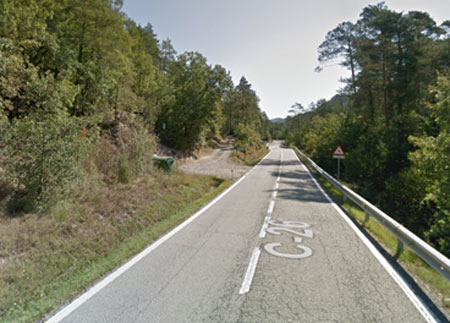
Where the track leaves the road. It is the same one for El Pati and for Capdevila.
Capdevila: the track everyone repairs
Capdevila is the house above, the big one, and it is the one there is least to tell about: there has not been much dealing between us. What there is, and what lasts, is a track.
The way up from the Vilada to Borredà road is a single one and serves both houses. It does not belong to one property: it crosses land with different owners all the way up. It is repaired and improved by everyone who uses it, and nothing more than an agreement has ever been needed.
Put plainly, it is one of the things that best explain how this works: no council comes up to fill in a pothole. An agreement between four houses is all the administration there is.
As for the rest of Capdevila, we tell that at length elsewhere, because El Pati was built inside its estate and the two houses share an origin.
Casteió: the girls who walked down to the factory
Casteió is the house on top of the hill, on the far side of the Mergançol. You can see it from El Pati, and from Casteió you could see the garden table at El Pati. Today it is a ruin.
The story was told by Maria Elisa Heras Heras, the aunt. The parents of Casteió left the house to the heir, as was done. He had sisters: two, three or four, and about that there is no longer any certainty. And since the house could not feed so many mouths, the sisters were put to work at the factory in Borredà: «in Borredà there was a little factory».
What comes next is four plain facts:
- They left home at five in the morning. The factory opened at six.
- They walked down from the top of the hill to the village, every day.
- At midday they walked back home, uphill.
- They set off in the dark, with no light but the moon.
Conxita measures it with the only yardstick she has: «for us, going to Borredà by car, it was about five minutes. Imagine it on foot.»
And then came the village festival
For the Mare de Déu in August there was dancing in the square at Borredà, and the girls walked down dressed up, in half-heeled shoes. And the village, like every village then, was cobbled, built for pack mules and not for heels.
So the girls would get cross and complain that the village was in a dreadful state, that you could not walk on it.
«And the aunts laughed, they did laugh, but they said: but they walk, they come down by goat tracks, these girls! And now they came to Borredà, which was cobbled and perfectly fine. And then, perhaps to make themselves a bit more interesting, they grumbled about the village.»
Conxita Gomis Bartomeus, recorded in 2026
It is better than a complaint. Four girls who come down a goat track six days a week and who, on the day of the festival, put on airs by complaining about the paving of the square. And the aunts, who know it, saying nothing and laughing.
How it ends, nobody knows: «they must have gone off to marry and they disappeared; the story, I know it only this far». Of the house she says it has had buyers interested, and that done up, «it is very beautiful for the view it has; it feels as if you touch the sky a little».
The day they got lost coming back
The two houses could see each other, but there was no path between them. One summer day Conxita and her mother walked up, following a cart track of the kind made for hauling timber out with the mule, which went up in zigzags. At the top they found the house half fallen in, the well, and herbs everywhere, oregano and thyme, ungathered: «since people did not come up, it was not picked either, it was all very wild».
Coming back they took another line and got lost. What frightened them was not the wood: it was the silence. They found their way by listening for the road.
Years later they came back with the children and marked the path with paint, and for a while that was how you got there. Today it is no longer needed: there is a logging track that reaches almost to the house.
What has been lost is the view. The two houses used to look at each other: from El Pati you could see Casteió above, and from Casteió you could make out the garden table at El Pati. Today, between the two, some pines that were small back then have grown and closed the gap. This photograph is taken from El Pati, looking towards where the house stands.
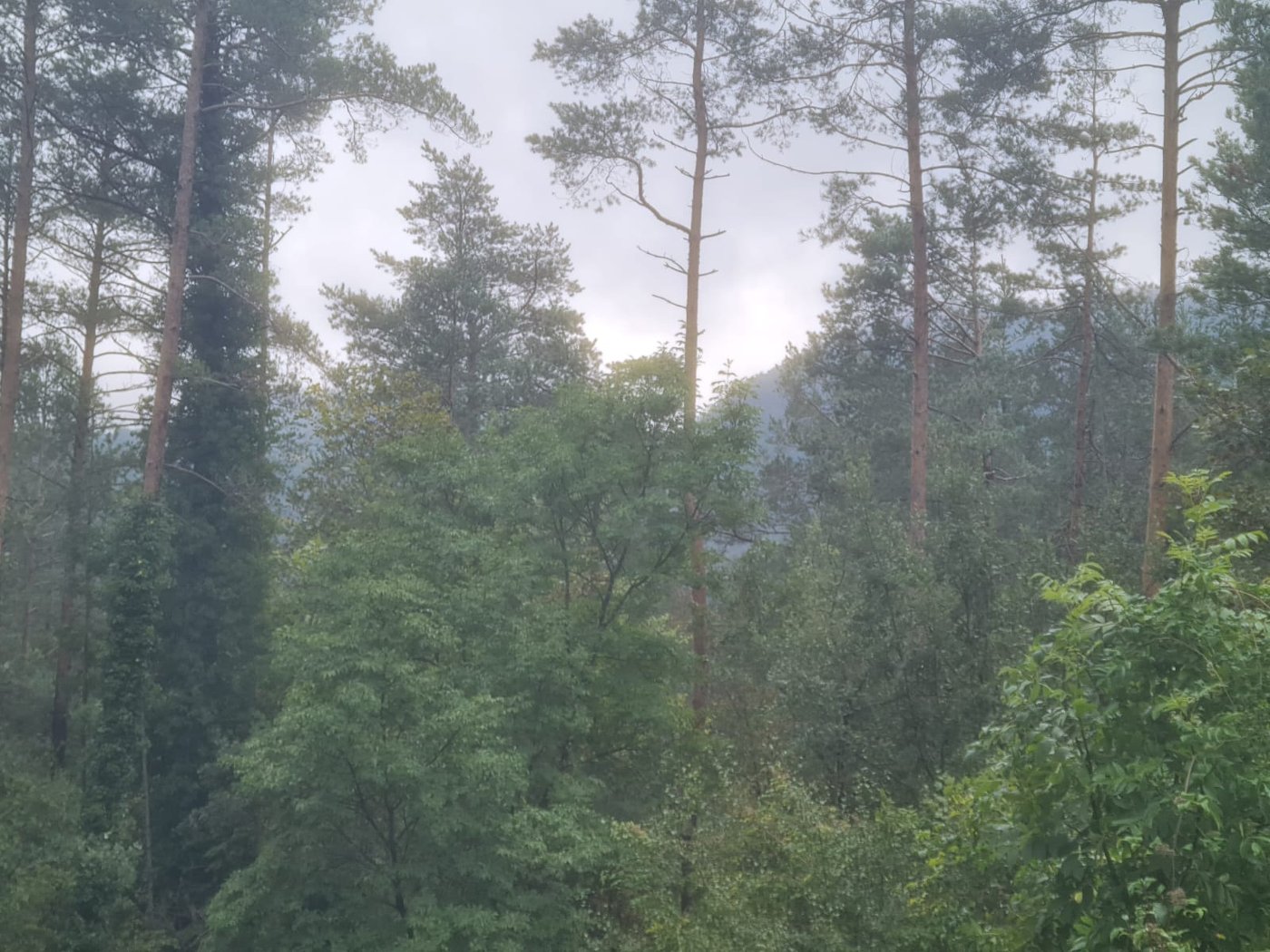
The view from El Pati towards Casteió. The house is behind those pines.
Casteió is private property and it is a ruin, with everything that means: floors that will not hold, walls that give way and an open well. We give no directions for reaching it and we do not advise going in.
Canemars: the three siblings
Canemars is a large 18th-century farmhouse of classic layout, with a double wooden balcony held up by a pillar and three segmental arches on the ground floor. Beside it stands a fine barn. It is listed in the Architectural Heritage Map of the Barcelona Provincial Council under the number IPA 3178, and the record places it in the former parish of Santa Magdalena de Guardiolans.
But what we remember of Canemars is not the house, it is the tenant farmers: three siblings we knew. Montserrat kept the house, Pep took out the herds and Jaume cut timber. Between the three of them they kept a whole farmhouse going.
Put like that it sounds like a division of labour, and it was something else: it meant the three of them barely saw one another. Pep went out with the livestock, Jaume went off into the woods and Montserrat stayed in the house. Alone, and for whole days with nobody to talk to.
Every summer we went up to see her, and she was very glad of it. And what she told us was that she found it hard to speak. Not that she did not want to: that it was hard, as though she were forgetting how. She talked to us when we came, and some Sundays when she went to mass.
This is what these houses held before there were cars and a road: a woman who kept a whole farmhouse going and who went weeks with nobody to talk to. Which is why that summer visit from the neighbours down below was not a courtesy call.
That same house had a mill of its own, the Molí de Canemars (IPA 3179), built around the middle or the end of the 18th century beside the Torrent Gran, near where it joins the Mergançol. It ground for Canemars and probably for the houses round about. Today it has collapsed: only part of the wheel pit and the first floor survive. If mills interest you, there are nine more on the Mergançol.
Les Eres de Guardiolans: the horse Llamp
Les Eres is the house that borders El Pati to the west, already in the municipality of Vilada. It is the oldest of all the houses visible from here: documented from the 14th century (IPA 3730), with some 400 m² per floor across three storeys, vaulted spaces on the ground floor, arcaded porches, barns, stables and a threshing floor.
It also has a chapel of its own, Baroque, with the date 1637 carved into the lintel and a two-opening bell gable. Before the civil war it held a Baroque altarpiece and paintings by Antoni Viladomat, which are no longer there.
The family succession is known in full: in 1443 Francina de les Eres marries Bernat de Merola; in the 16th century the house comes to be called Comelles; in the 19th it marries into the Anglerill family of Olvan.
And what tied us to it was far more modest than any of that: a stable. Les Eres had a livery stable and kept horses for whoever needed it. Ours was there. He was called Llamp, which in Catalan means lightning.
And it ended badly. Llamp got out of the stable, kicked a swarm of bees and died of the stings.
We went to see him in his last moments. He gave us a few tears of farewell.
It is the only story on this page that does not come from my mother's recordings: this one I saw myself.
Of the five houses, les Eres is the only one that not only tells its history but opens its doors: it is registered rural accommodation, number PCC-000013, with six rooms and fifteen places. We say so because this page rests on telling things as they are, and keeping quiet about the neighbour who also lets rooms would be the one thing that would give it the lie.
Pradell: the neighbour who climbed up to warn us
Senyor Pradell was an old man who had been there all his life, in the house that borders the Capdevila estate to the west. He was a neighbour in the old sense of the word: the one who is there, and who by being there is good for something.
Storms here were another matter. Conxita puts it this way: «there were storms of lightning and thunder that seemed to carry everything away». She would put the children inside the car, because she had heard that lightning does not strike inside a car.
One day lightning brought a tree down across the track. Senyor Pradell walked up on foot from his house to ours, to warn us and to see that we were all right. He arrived with his boots caked in mud to the knee. My father was not there, and what he said to my mother is exactly what explains what a neighbour is for:
«Quick, tell your husband when he comes to go down to the track, the lightning has brought a tree down and it is lying across the road and the grandparents will not be able to get up.»
Senyor Pradell, as remembered by Conxita Gomis Bartomeus
He did not telephone, because there was no telephone. He walked it.
There is another thing from those years worth not losing: how the weather was forecast without television. You went out after lunch, looked at the mountains to see whether they had darkened and remembered what it had done the year before at the same time. And in this house the one who was almost never wrong was her.
One September, in the middle of the mushroom season, she warned a cousin who was a great walker and very knowledgeable: «it is going to rain, don't go». She said it because for days she had been watching the clouds gather always in the same place. The cousin laughed and went. He came back an hour later, soaked.
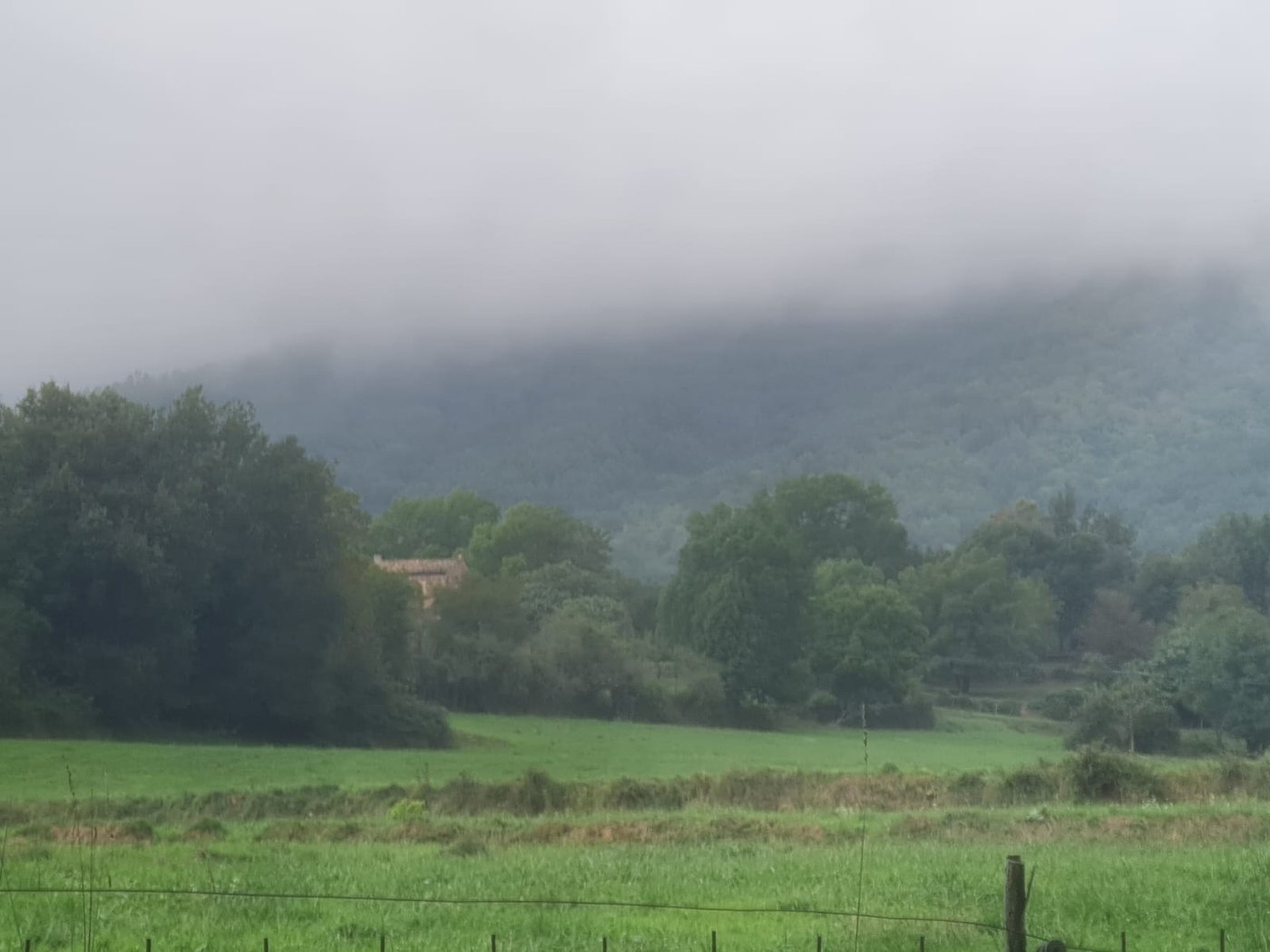
Pradell, seen from our track.
They are all private houses
It is worth saying plainly, because this page tells stories and stories make people want to go and look. None of these houses is a monument open to visitors. Capdevila, Canemars and Pradell are private homes; Casteió is a dangerous ruin, with collapsed floors and an open well. There are no waymarked paths leading to them and the land is private. Les Eres you can go to, but as a guest and by booking with them, not as someone visiting a historic building.
What you can walk freely is the valley they stand in, and that is what the Around Borredà page is for: the gorgs of the Mergançol, the mills and bridges of the same river and the Picancel range.
If you want to know this valley from the inside, you can sleep in ours:
Frequently asked questions about the farmhouses around El Pati
Which farmhouses are there around El Pati?
Five: Capdevila, directly above and inside whose estate El Pati was built; Casteió, on top of the hill across the Mergançol, today a ruin; Canemars, an 18th-century farmhouse listed as IPA 3178; les Eres de Guardiolans, documented from the 14th century, already in the municipality of Vilada; and Pradell, which borders Capdevila to the west.
Can they be visited?
As monuments, no: Capdevila, Canemars and Pradell are private homes and Casteió is a dangerous ruin, with collapsed floors and an open well. There are no waymarked paths leading to them, the land is private and we give no directions for access. The exception is les Eres de Guardiolans, which is rural accommodation and can be visited by staying there.
Why are these houses so far apart from one another?
Because they are farmhouses, not a village: each house stood in the middle of its own land. What grouped them was the parish, in this case Santa Magdalena de Guardiolans, documented from the year 996 and today gone as such. The church still stands in the municipality of Vilada.
Who owns the track up to El Pati?
It does not belong to a single property: it crosses land with different owners. Everyone who uses it repairs and improves it, by agreement between the houses, with nothing written down.
What was the factory in Borredà?
A small factory in the village where the sisters of the heir of Casteió worked. They left home at five in the morning to start at six, walked down from the top of the hill and came back uphill at midday. It is the most concrete part of everything told here.
Is it spelt Casteió or Castelló?
At home it has always been said Casteió, and that is how we write it. They are the same name, and official sources and maps may use the other form, so it is worth searching for both.
Sources
- Recordings of Conxita Gomis Bartomeus, 2026, kept by the family. From these come the stories of Casteió, of Senyor Pradell and of the storms, and the quotations on this page.
- Architectural Heritage Map of the Barcelona Provincial Council, record of Canemars, Borredà (IPA 3178, record 08024-43): 18th-century farmhouse in the former parish of Santa Magdalena de Guardiolans.
- Architectural Heritage Map of the Barcelona Provincial Council, record of the Molí de Canemars, Borredà (IPA 3179): 18th-century flour mill beside the Torrent Gran, now collapsed.
- Architectural Heritage Map of the Barcelona Provincial Council, record of les Eres de Gardilans, Vilada (IPA 3730, record 08299-6): farmhouse documented from the 14th century, succession of owners and family chapel.
- Heritage documentation on the chapel of les Eres de Guardiolans: date of 1637 on the lintel, two-opening bell gable, Baroque altarpiece and paintings by Antoni Viladomat held before the war. The sources disagree on its dedication.
- Enciclopèdia Catalana, Santa Magdalena de Guardiolans or de Gardilans (Vilada): mention of the place in 996, citation of the church in the consecration act of the Seu d'Urgell of 1001, parish status in 1227 and present condition.
- Deed of the Capdevila estate, which fixes the Pradell farmhouse as its western boundary.
- Accommodation directory of the Berguedà county council, record of les Eres de Guardiolans: agritourism with registration PCC-000013, six rooms and fifteen places.